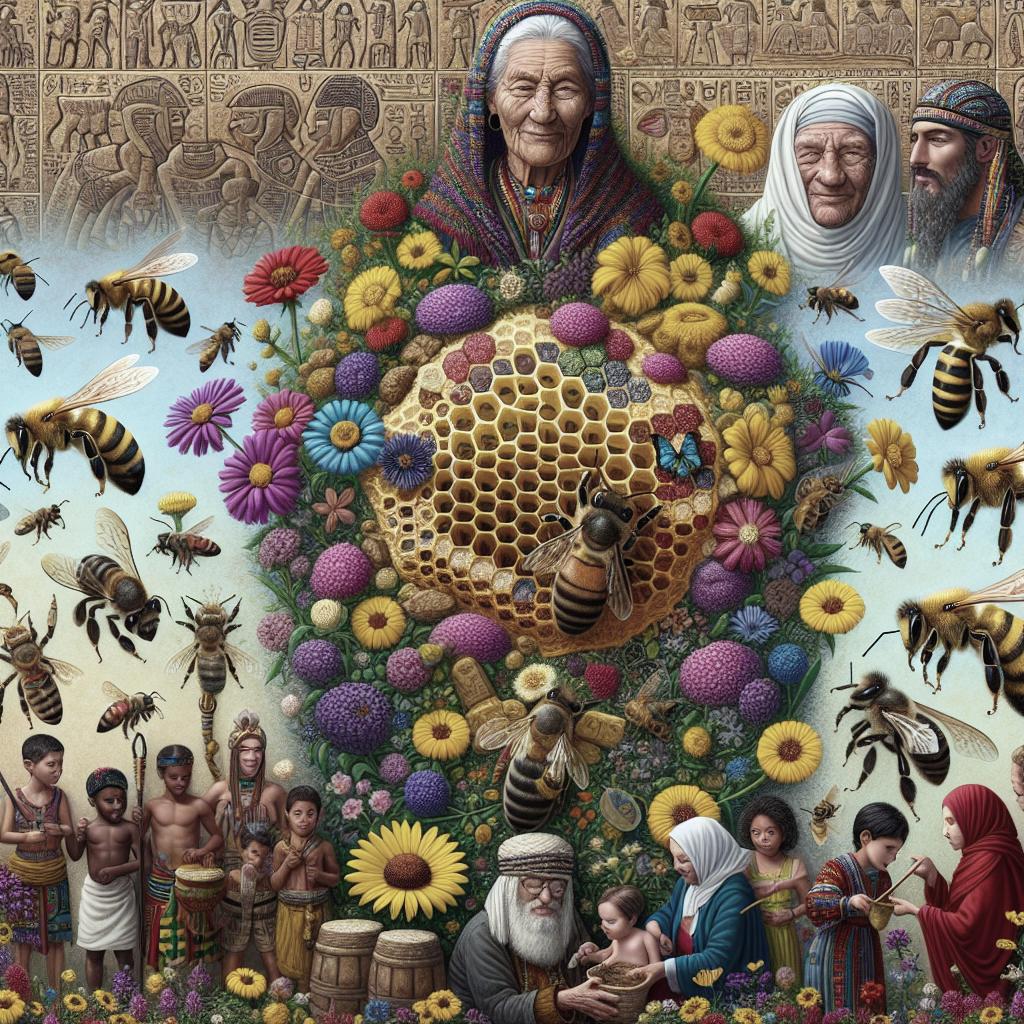
The Historical Roles of Bees in Various Cultures
Throughout history, bees have played influential roles in many cultures worldwide, serving as symbols, sources of sustenance, and hallmarks of innovation. In ancient times, the art of beekeeping with skeps and log hives laid early foundations. With technological advancements, modern methodologies emerged, such as Langstroth’s moveable frame hive. Despite this evolution, many regions maintain traditional practices alongside new innovations. Furthermore, bees have been deeply woven into our cultural consciousness, represented in myriad spiritual and symbolic contexts. This exploration unpacks these historical avenues, illustrating the rich tapestry of our past relationships with the honey bee.
Ancient Beginnings: Skeps and Log Hives
The earliest forms of beekeeping trace back to skeps and log hives, showcasing humanity’s initial attempts to harness bees’ incredible work ethic. Skeps, simple domed structures made of straw, clay, or wicker, are archaeological artifacts found in Europe and the Middle East, demonstrating an age-old symbiotic relationship. These initial designs facilitated honey and wax extraction, although without the sophistication of modern hives.
Log hives, or ‘bee gums,’ were hollow logs scaled for bee habitation, utilized primarily in Northern Europe and Africa. These traditional hives capitalized on natural bee behavior, providing a protective structure that mirrored bees’ preference for dark, insulated cavities. Despite their limitations, such primitive techniques laid the groundwork for more innovative beekeeping practices that would emerge through the centuries.
The Birth of Modern Beekeeping: Langstroth and the Moveable Frame Hive
The invention of the moveable frame hive by Lorenzo Langstroth in the 19th century revolutionized beekeeping. This innovation allowed for easier access to honeycombs and a more sustainable way to harvest honey without destroying the bee colony. The Langstroth hive introduced the concept of bee space, a gap that allows bees to move freely without sealing the space with propolis, making hive inspection and management significantly more efficient.
This modern approach sparked a transformation in apiculture, enabling beekeepers to scale operations and improve bee colony health management. Langstroth’s design has become the cornerstone of contemporary beekeeping practices, reflecting a pivotal moment in human ingenuity to harmonize with natural systems.
Variations and Innovations
Beekeeping practices have evolved across different cultures, incorporating regional variations and innovations that cater to local climates and ecological settings. The Top-Bar Hive, widely used in African countries, provides a simple, cost-effective solution for small-scale beekeepers. Its design maximizes honey production while making hive management accessible and sustainable for developing communities.
In Asia, traditional methods like the Indian Bait Hive and the Japanese Warre Hive showcase localized ingenuity. These approaches reflect cultural adaptability, using indigenous materials and techniques to maintain beekeeping’s relevance and effectiveness in diverse environments.
Preserving Tradition, Embracing Innovation
While technological advancements in beekeeping continue to thrive, many communities remain rooted in ancient traditions. Some cultures, like the Maya of Central America, still practice traditional stingless beekeeping, honoring ancestral techniques that are intrinsically linked to their cultural heritage.
Conversely, modern beekeepers balance tradition with innovation, embracing new technologies such as precision beekeeping, which uses sensors and AI to monitor hive conditions. This duality reveals a dynamic interplay of respecting historical practices while adopting advancements that ensure bees’ and beekeepers’ future sustainability.
The Representation and Symbolic Meaning of the Honey Bee through Time
The honey bee has held significant symbolic meaning throughout history, often representing aspects like diligence, community, and abundance. Ancient Egyptians revered bees as symbols of royalty and used honey in rituals and as offerings to their gods. In classical Greece, bees were linked with the divine realm, associated with the goddess Artemis and believed to possess prophetic powers.
During the Middle Ages, bees were seen as paragons of virtue and industriousness, and their structured colonies were a metaphor for a harmonious society. Today, bees continue to be powerful environmental symbols, embodying ecological health and the interconnectedness of natural systems, reminding us of our stewardship responsibilities toward the planet.
You may also like
-
The Role of Technology in Modern Beekeeping
-
The Cultural Significance of Honey Through History
-
Bee-Friendly Practices: Creating Sustainable Habitats
Next Steps
| Section | Content |
|---|---|
| Ancient Beginnings: Skeps and Log Hives | Explored early beekeeping methods using skeps and log hives, highlighting their functionality and limitations in ancient times. |
| The Birth of Modern Beekeeping | Described the Langstroth hive’s pivotal role in modernizing beekeeping and its lasting impact on apiculture practices. |
| Variations and Innovations | Discussed regional adaptations in beekeeping practices reflecting cultural and environmental dynamics. |
| Preserving Tradition, Embracing Innovation | Examined the balance between maintaining traditional practices and integrating new technological advancements in beekeeping. |
| The Representation and Symbolic Meaning | Showcased how bees have been powerful symbols throughout history, carrying various cultural significances. |